Wednesday, January 16, 2008

Things I learned this weekend

I learned a few things this weekend at a retreat. There were a half dozen couples who met in upstate New York to talk. And talk. And talk. Two full days of conversation from dawn to dusk and into the night--we'd only relocate for meals (or an occasional walk or bball)--but the conversation never really stopped. It was GREAT!

Things I learned:
  • God is alive and active in his world. He never stopped working and he never stopped speaking. Most people never hear him because they don't know how to or even that it's possible.
  • Listening isn't enough regardless of who you're talking with. To really begin to understand each other all parties involved should try to hear the others. Listening isn't enough. (Let those who have ears to hear, hear. And be assured that God gives good gifts to his children when they ask him: Ask, seek, knock.)
  • There's a wonderful sense of peace that comes when I no longer feel like I must say the things I'm thinking. I can wait and let other people speak first (their comment might be much more important or profound). Once a few seconds of silence have passed, then I can say what I want to--if I still want to. I don't have to share everything I think of.

Labels: , , ,

Monday, January 07, 2008

Charismatic Tithing??

Don't start getting spoiled, but there have been too many "coincidences" in the past 12 hours to not share.

A bit of back story: Over the past several months/years I've had a staggering number of conversations about social justice and the Christian's proper response to helping those in need. I'm still thinking through the issues, but I'm definitely now more on the side of, "Let's do everything we possibly can to help restore as much of everyone's humanity as is possible!!"

So, for those of you not in a simple church you might not realize that we have no real expenses up here. We meet in houses. We feed each other whenever we get together. We share and just basically love being together, but we have no building, no mortgage, no heating (well, we do, but heating houses hardly counts. Although it feels like it should with $400+ heating bills--see my previous post.).

You might say, "So what's the problem? That hardly seems like something to complain about!" I'll tell you. Where does the money go? We need to be generous, but we don't have the "easy" option of just giving money to "the church" and washing our hands of the matter. There are so many good options out there, but I haven't been giving nearly enough of myself or our money.

Isaiah phrases it interestingly (check out the context):

If you spend yourselves in behalf of the hungry
and satisfy the needs of the oppressed,
then your light will rise in the darkness
and your night will become like the noonday.


Spend yourselves? How do I spend myself everyday? In a chasing after the wind? In pursuing religion?

Or in pursuing God and what He cares about?

Back to all the coincidences. Last night Adam W, a great friend who recently joined our group of Christ-followers, went to talk about a stewardship campaign at a local parish. While taking his wife, Nikky, home I asked what their experience with the Health and Wealth gospel has been. She hadn't ever heard of it.

Their position is that if a body of believers has committed to each other then they must share responsibility in all areas, including the finances.

Including the mortgage and heating.

What a profoundly simple idea. It makes so much sense.

This morning I was eating at my regular breakfast nook, The Broken Yolk, when the cook asked me if I had my Bible with me today. She was interested if I knew the verse where we were told to give 10%. I went off into a long diatribe on how that was never commanded of us--Abraham set a good precedent and Jacob after him, but we don't have to. We have to be generous with out lives.

Fortunately someone came in a placed an order, so she sent me looking in Ecclesiastes (where I found the profound wisdom I linked to above). I had some time to realize I was not having a conversation, I was teaching. When she came back to my table we talked, she read Ecclesiastes 5, she found Malachi 3:10ff, and we had a conversation.

I then realized I had been answering the wrong question. There are several commands to give 10% (literally "a tithe"), they just all happen to be in the Hebrew Bible.

Several months ago she had told me that her community is an Assembly of God in Revere. Before leaving I asked her about it (since yesterday's sermon had been on tithing) and she told me that it's a Spanish congregation and she'd love to have me visit. They even have a wonderful lady who will translate into English whenever someone shows up who would otherwise be lost.* I'm really looking forward to visiting soon.

The final coincidence was that George Barna had sent me his weekly study of American demographics while I was at breakfast. Here it is. Definitely something to think about.


*LOST. Isn't that a great word? I just finished a book AKA Lost that talks about how demeaning it is to even think that way. We strip people of their humanity when we don't think of them as humans, but rather "the lost." However, I most certainly would be lost at a Spanish congregation without a translator. Perhaps the word isn't all bad . . .

Labels: , , , , , , ,

Saturday, August 18, 2007

Stardust

Just came home from the local AMC after seeing what very well might be the best movie I've ever seen. I don't want to be too dramatic (that and I tend to have a very bad memory, so I think "the very best movie I've ever seen" changes rather frequently), but I really do give Stardust my highest recommendation.

For any of you who have ever read John Eldridge (Wild at Heart, Captivating, Epic, The Journey of Desire, . . .) you'll know what I mean when I say that movie belongs in his books. Actually I'd say that this movie is the quintessential story (aside from the real story of God's romancing us back to himself) illustrating Eldridge's thoughts.

With humor reminiscent of The Princess Bride, this epic, magical, and truly romantic fairy tale really stirred my heart.

Labels: ,

Monday, August 06, 2007

Trusting God

I love the days when God just really leaves no doubt how much he love us. Yesterday was one of those days.

I suppose I should start at the beginning. A week ago I was sitting at school and had a thought--we should probably move. Now this wasn't a new thought, but it really just struck me. So I called Jen up and asked her if she wanted to give 30 days notice to our landlord (since it was the 31st of July). She said "sure," so I made the call. One of our good friends told me a couple days later, "Taylor, a spontaneous action like that sure seems out of character for you"--I'm glad I can keep him guessing.

Well, of course we started an eager search for a new place in Quincy. Our primary criteria for our new place was either (1) near Germantown (the roughest neighborhood in Quincy--demographically categorized as "struggling urban diversity") or (2) near someone else on our team (walking distance so we can start living out this idea of doing life together in Christian community). (Other criteria included minimum 2 bedrooms--for when you come visit us--and a separate dining room since eating together is central to Christian community). Since we had a bit of a time crunch we decided we should decide on a place by the end of the weekend. Criagslist provided many leads, but most wouldn't quite work for one reason or another.

Coming up to Sunday we had a couple "it'd be alright" places, but nothing we loved, but we had two final apartments to see Sunday afternoon. For some strange reason I was never worried about finding a place--I had no doubt that God wanted us to move according to his above criteria (his vision) and so he'd certainly reserve the place he wanted us at (his provision). As my friend said above, this is not normal behavior for me--I tend to stress and worry about things far less life changing than this. Well, I take that back, this sort of trust is actually becoming increasingly more normal. What a joy to recognize God's hand in continually transforming me into the sort of person he wants me to be.

Well, we go to our first Sunday appointment and I knew from the moment I saw the staircase leading up to the apartment that this was our place. Seeing the rest merely confirmed that (as did seeing the radiant smile on Jen's face). We did go to the other appointment since Meghan has told us how horrible it is to have people stand her up, but as soon as we walked out that door we found some shade and filled out the applications for the first place. As it turns out, our new landlords are amazing people (you could call them people of peace) and they live about a block away from our new place. I'm eager to cultivate a friendship with them and the people in the neighborhood they know. Meghan and Taylor are also about a block away (as are the beach and the subway), so we really couldn't ask for anything more perfect. God has truly made good on his promise (and early too).

All praise to our Lord and Father forever, for his goodness is astounding and infinite.

----
An interesting bit of trivia. We'll now be living on Botolph St. St. Botolph is the patron saint of travelers, and a town Lincolnshire is named after him--Boston (a corruption of "Botolph's Town"). I bet you can guess which English city Boston, MA was named after. Details here.

Labels: , ,

Tuesday, July 24, 2007

Forcing "Jerusalem" to Happen

A Dallas Willard quote in response to Steve's question about if the American Experiment has failed:
[On the new earth and] in this new city--"Jerusalem," or "the peace of God," is its name--"all cultures and languages will come together to see God in his glory (Isa. 66:18). They will transmit that vision of God throughout all of the earth, and all humanity will come regularly to the center of divine presence on earth, to delight in God and worship him (vv. 19-23).
The power of God's personal presence will, directly and indirectly, accomplish the public order in and among nations that human government has never been able to bring about. Truth and mercy will have met and kissed each other at last, like long-lost friends (Ps. 85:10). Grace and truth are reconciled in the person of the Son of man (John 1:17).
The greatest temptation to evil that humanity ever suffers is the temptation to make a "Jerusalem" happen by human means. Human means are absolutely indispensable in the world as it is. that is God's intention. We are supposed to act, and our actions are to count. But there is a limit on what human arrangements can accomplish. The alone cannot change the heart and spirit of the human being.
Because of this, the instrumentalities invoked to make "Jerusalem" happen always wind up eliminating truth, or mercy, or both. World history as well as small-scale decision making demonstrates this. It is seen in the ravages of dictatorial power, on the one hand, and, on the other, in the death by minutiae that a bureaucracy tends to impose. It is well known how hard it is to provide a benign order within human means. For the problem, once again, is in the human heart. Until it fully engages with the rule of God, the good that we feel must be cannot come. It will at a certain point be defeated by the very means implemented to produce it.
feel free to stop reading there (that's the main responce), but Willard continues:
God's way of moving toward the future is, with gentle persistence in unfailing purpose, to bring about the transformation of the human heart by speaking with human beings and living with and in them. He finds an Abraham, a Moses, a Paul--a you. It is this millennia-long process that Jesus the Son of man brings and will bring to completion. And it is the way of the prophets, who foresaw that the day would come with God's heart is the human heart: "the law of God would be written in the heart." That is, when what is right to God's mind would be done as a simple matter of course, and when we would not be able to understand why anyone would even think of engaging in evil. That is the nature of God's full reign [i.e. the Kingdom of God].
All of the instruments of brutality and deceit that human government and society now employ to manage a corrupted and unruly humanity will then have no use. As, even now, the presence of a good person touches, influences, and may even govern people near-by through the respect inspired in their hearts, the focused presence of the Trinitarian personality upon the earth will govern through the clarity and force of its own goodness, and indirectly through its transformed people.
Thus we see repeated portrayed in the prophecy the gentleness of this government--for the first time a completely adequate government, in which the means to the good do not limit or destroy the possibility of goodness. The beautiful prophetic images portray the divine way of operating: "Your true king is coming to you, vindicated and triumphant, humble, mounted on a donkey. His word will bring peace to the nations, and his supervision will take in all lands, from where his presence is centered to the farthest reaches of the earth" (Zech. 9:9-10).
Divine presence replaces brute power, and especially power exercised by human beings whose hearts are alienated from God's best. "I will focus my being in their midst forever. And the nations will know that it is I the Masterful Lord who makes my people different" (Ezek. 37:26-28).
The Divine Conspiracy by Dallas Willard, pp. 380f.
As long as we humans act like we're God (and God's not) there's no real hope for any human institution. But the day described above will come. I long for it. Don't you?

Maranatha, Lord Jesus!

Labels: , ,

Tuesday, May 29, 2007

The Creative Process

My good friend Chris (who also happens to be Quincy's newest resident) responded to my post "Why Photography" over at Narf's Cavern. I'd recommend you go read his profound insights there before you continue reading this.
I suppose there’s more evident arrangement and technical skill involved in lyric writing than photography, but I imagine some photographers out there would happily disagree. Nor is it true that personal skill always shines through lyrics while great photographs minimize the role of the photographer. The truly great songs are the ones that are so natural, so perfectly affecting, that they don’t seem written at all. It floors us that great songs were “written” because they seem to us to have been “discovered.” I suspect, in a very deep sense, they were.
Chris, I couldn't agree more with you. The photograph is full of the photographer just like the lyrics are full of the composer. Hopefully they've uncovered something deep and true that already existed, but they bring their identity and vision to what was there so now there is this neat partnership or pairing of the two. Both are essential for the final product to ever exist.

[side note:
Perhaps we can use this as an illustration of the Trinity and how the Holy Spirit partners with us. The product of creativity should be full of us, and yet it should also be full of God (the object reflects God's glory--we capture it and then reflect it again). So, we humans are in one sense wholly responsible for the final product, but in another sense God is the one who is wholly responsible. The product is full of both God
and us, and yet it is unified. Similarly, the God is full of the Father, Jesus, and the Holy Spirit and yet is singular and whole. Or, Christians are wholly ourselves and yet wholly dead to ourselves so that God can live in us and direct us. In that process our individuality is accentuated through partnership with God.* Just because something seems paradoxical or contradictory doesn't mean it is necessarily false. Some mystery is good.]

God seems to work like this everywhere. He's chosen to reveal himself through music and nature, people and governments, his Church and himself, but he still relies on those people and organizations to be an accurate reflection of him in order to glorify his name. I can choose not to honor him (much like I can choose not to take a beautiful photograph when I see it in front of me)--it doesn't mean God's any less deserving of honor (or the scene is any less strikingly beautiful)--it only means that I've decided not to participate in that greatness, that beauty. In the truest sense it is "my loss."

But God loves individuals, and small groups, and huge institutions, and all of creation. He actually is smart and big and powerful enough to get his mind around such big and small things at the same time. Probably my favorite verse in John's Revelation to the Church is:
He who has an ear, let him hear what the Spirit says to the churches. To him who overcomes, I will give some of the hidden manna. I will also give him a white stone with a new name written on it, known only to him who receives it.
--John telling us how God intimately knows each of his children

I think I'll let Chris close:
I’d like to think that it’s not pride to recognize when something is good, to recognize when you have a talent for sharing that with people in artful ways, and to take joy in what you’ve done. That’s a gift and we ought to treasure it. We are told to think on whatever is right, noble, pure, lovely, virtuous, etc. and so it seems like a good idea to me to be pumping out as much lovely, noble, pure stuff as we can, so we have more to think on.

-----------------------
* Rather than being absorbed into a universal consciousness where we lose all sense of identity like some religions propose.

Labels: , , ,

Thursday, May 24, 2007

Why Photography?

I was asked "why photography?" when I joined the Boston Photography Center. I think I finally figured part of that question out:

Photography, unlike most art forms, generally doesn't attempt to create. Rather, a good photographer will see the beauty surrounding him in every moment and capture it. He freezes the essence of the world in that place and time. Therefore, a photographer should be humble--his job is to capture (reflect) the inherent glory of creation in his work.

A parallel: as Christians, we too should learn to be fully present in every moment. Then we can humbly always be reflecting the glory of God to those around us.

Labels: , ,

Monday, April 30, 2007

Willard on Discipleship and Heaven

Perhaps I'll get back to posting once finals are over, but for now here's a quote from Dallas Willard.

From The Divine Conspiracy (page 301f):

The division of professing Christians into those for whom it is a matter of whole-life devotion to God and those who maintain a consumer, or client, relationship to the church has now been an accepted reality for over fifteen hundred years. . . . It is now understood to be a part of the "good news" that one does not have to be a life student of Jesus in order to be a Christian and receive forgiveness of sins. This gives a precise meaning to the phrase "cheap grace," though it would be better described as "costly faithlessness."


. . . I want it to be very clear that I am not saying only "true disciples" of Jesus make it to heaven after death. Indeed, I believe that that is not t rue, though I would not encourage anyone to stop short of discipleship. Nevertheless I know that as far as forgiveness alone is concerned, the tenderness of god is far greater than we will ever understand on earth or perhaps elsewhere.


That is surely what it means to say that he gave his unique Son to die on our behalf. I am thoroughly convinced that God will let everyone in to heaven who, in his considered opinion, can stand it. But "standing it" may prove to be a more difficult matter than those who take their view of heaven from popular movies or popular preaching may think. The fires in heaven may be hotter than those in the other place.


. . . There is a widespread notion that just passing though death transforms human character. Discipleship is not needed. Just believe enough to "make it." But I have never been able to find any basis in scriptural tradition or psychological reality to think this might be so. What if death only forever fixes us as the kind of person we are at death? What would one do in heaven with a debauched character or a hate-filled heart?


-------
On a side note I won second place in the Tufts Graduate Student Photo Contest with these two pictures (two which I wouldn't have put at the top of my submissions):


Labels: , ,

Friday, April 06, 2007

The Ineffectiveness of Talking Head Preaching

I've been thinking about and struggling with the concepts of teaching and preaching as they applied in the early church and in house churches. I read this today over on the House Church Blog. I think that some of the problems with preaching (as done) are accurately diagnosed, and a treatment is offered as well. Check it out and let me know what you think--I'm still trying to figure this one out.

Labels: , , ,

Boundry Conditioning

Here's an interesting video. I think it has implications for the Church. (HT* The Forgotten Way)


This PS2 add (I really don't get how it's advertising the PS2) is a great illustration of the problem of centered vs bounded sets. Michael Frost and Alan Hirsch discuss this concept in their book, The Shaping of Things to Come (an excellent book that I'd recommend to anyone who has any interest in the past or future of the body of Christ). Ben Cheek also references this idea in his very good e-book examining the person of Jesus, Revolutionary. Since I'm short on time (and since he does a better job than I can) I'm going to quote from Ben (book 4 page 9 and following).
Frost and Hirsch use this as an illustration to demonstrate the difference between bounded sets and centered sets. A set is a collection of objects, or in the case of the spiritual community, people. A bounded set is a group of people defined by their boundary and by their separation form others. On the other hand, a centered set is defined by their center and their relationship relative to that center (how close they are to the center).

Churches that see themselves as bounded sets have a clear line of who’s in and who’s out. Those inside the boundary all have certain minimal qualities in common like baptism, membership, doctrine, etc. The point is to get unbelievers or non-Christians to become believers or Christians by crossing the boundary. The work of the leaders is to tend the fence, make sure none of those inside “cross the fence” and are lost, and in some cases they prevent others from getting in who are outsiders and don’t
belong.

In contrast, churches that see themselves as centered sets have no clear line of who’s in and who’s out — in the broadest sense of the group, everyone who has any kind of connection at all is in. What all the people have in common is a relationship to the center, but these relationships vary considerably in closeness, quality, strength, and style. The point is — whether you consider yourself a Christian or a not-yet-Christian — to move closer to the center of the set: towards Christ and his core values. The work of the leaders in a centered set community is to link to people and to the center. Like rescue workers, they use their relationship to Jesus as an anchor line, while they extend relationships to those farther out (regardless of their Christian/non-Christian, member/non-member status), which they use to pull them in closer.

I'd recommend picking up Shaping or downloading Revolutionary. This is an important thing for Christ's church to think about.

-----
* HT: (I just found this today) blogging jargon for "Hat Tip" or, in other words, the source for where the blogger found the content for his blog

Labels: , ,

Monday, March 12, 2007

Inadiquacies in the Naturalistic Evolutionary Model

I'm intimidated by that title, but it's the best I could come up with in six words.

I just got out of the most enjoyable Biomedical Engineering seminar in my life (I've only attended a dozen or two, but still . . .). It was interesting, well presented, and I actually had enough background to understand what he was saying. That's certainly preferable to sitting for an hour on Mondays completely confused and feeling inadequate. Perhaps I am actually learning something.

Well, the seminar was by David Walt (Tufts Chemistry Professor) on Optical Fiber Microarrays. Now I'm not going to pretend to understand what he said well enough to explain it to you (and I'm not going to pretend that you'd be interested if I could), but one comment he made in the Q&A section made me think.*

Someone asked if his setup (which can be used as a "nose") gives us any information about how biological noses actually work--how many specific types of sensors we have. He said that it's interesting because theoretically and experimentally it only takes about 100 distinct sensors to detect every (practically) possible combination of odors; however, humans (and dogs for that matter) have around 1000 distinct sensors. He didn't seem to think there's any practical reason why we should have evolved such a unnecessarily precise array of sensors. I was thinking, "Wow, God's such an overachiever. He's amazing." It made me smile.

* On the off chance you are actually interested: Here's his site which I'm sure has more information than you'd ever care about.

Labels: , ,

Saturday, February 03, 2007

An answer from C.S. Lewis

Jen and I were listening to a lecture this morning on The Life and Writings of C. S. Lewis by Louis Markos (good stuff if you want to check it out from the library). I like his line of reasoning, so I'm transcribing it for you.

From lecture 3: Ethics and the Tao
What is the strongest evidence against Christianity? The strongest argument is "look at all the injustice and suffering in the world, how could a good God have created it?" That is really, to me, the best attack on Christianity--why is this world so unjust? But do you know what Lewis says? How do we know our world is unjust? The only way we could know our world is unjust is if we have a just measure to measure it against. Do you follow me here? To put it in C. S. Lewis' words, "a man does not call a line crooked unless he has some idea of a straight line." How do we know that the world is unjust and unfair unless we have some kind of supernatural standard to tell us what is just and what is fair. So, you see, the greatest argument against Christianity becomes an argument in favor of it.

Labels: ,

Friday, November 10, 2006

The Little Mermaid (a parable)

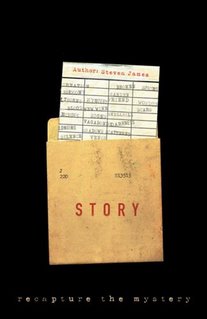
This is from Steven James' book Story: recapture the mystery:

In Has Christian Andersen's original tale of "The Little Mermaid" (not the Disney version), a beautiful young mermaid has fallen in love with a human prince. The mermaid is a glorious singer beneath the sea, but she gives up her voice to be able to become human and love the prince. The deal is, if she can woo him, then she can remain human and receive an eternal soul. But if he marries another woman, the little mermaid will turn into sea foam, the fate of all mermaids.

Well, despite all her devotion to him, the prince's heart remains enamored with a different woman, a princess whom he believes rescued him from a shipwreck. However, the little mermaid was really the one who had saved him. She wants desperately to tell him that she was his savior and that she loves him, but she has no voice above the sea, no words he can hear.

In the end, all three are sailing back to the prince's palace for his wedding to the other woman. The little mermaid is about to turn back into sea foam when her sisters swim to the water's surface and offer her a knife and a choice: if she will take the prince's life, she need not give up her own. The magic can be reversed; she can become a mermaid again if only she will kill the prince. One of them must die before daybreak.

Everyone else is asleep on the boat. Silently the little mermaid approaches the prince and finds him in the arms of the other woman. As Hans Christian Andersen writes,
The knife trembled in the hand of the little mermaid: then she flung it far away from her into the waves; the water turned red where it fell, and the drops that spurted up looked like blood. She cast one more lingering, half-fainting glance at the prince, and then threw herself from the ship into the sea, and thought her body was dissolving into foam. The sun rose above the waves, and his warm rays fell on the cold foam of the little mermaid.1

The prince knew nothing of her sacrifice, nothing of her love. He didn't know she had rescued him, giver up her beautiful voice to become like him, and then exchanged her life for his. All this went on while he pursued another woman. She sacrificed all for her prince because she loved him, yet he never returned her love.

When the gospel is told like that, I can understand it.

God's love didn't happen in a courtroom but on a cross where Jesus threw himself from the ship and into the sea. The story I see woven all throughtout Scripture is a tale of passion and sacrifice--not a deal brokered between a lawyer and a judge. It was a gift given from a lover to his beloved: in one final act of sacrificial love, he offers his life so that she might live.

We have a God who would let himself be nailed to a cross for his beloved. And there he would dare to die for her. For us.

Hold onto this moment. See him hanging there, between heaven and earth. Between God and humanity. See him dying there on Skull Hill. Don't turn away. Easter will never make sense without this moment.2

----------
1. Hans Christian Andersen, The Complete Hans Christian Andersen Fairy Tales, ed. Lilly Owens.
2. Stephen James, Story: recapture the mystery.

Labels: ,

Tuesday, October 10, 2006

For the Computer Nerds

Several months ago Jen and I purchased a new television. I also convinced my lovely wife that she'd appreciate my having a TV tuner card for my computer. (I convinced her that we would no longer need a VCR and could therefore save a bit of space during the move.) I encountered a problem though, I couldn't get the video signal from my computer to the television. Over the past month or so I've tried everything I could think of without success. But a couple nights ago it occurred to me that I haven't updated my video card drivers for quite some time. I updated and within a half hour I had everything running like I had hoped it would for so long. I was so proud of myself for finally getting it to work.

The next day I was cleaning up and it occurred to me that I really wasn't personally responsible for most of the work that made my system work. Most of the credit should really go to the programmers and computer engineers who have spent years of their lives to develop the products and software. All I did was purchase, put together, download, and install--all comparatively small tasks. However, without my having participated in the process my computer and television would still have significant communication issues. So, even though I didn't do much I still had to do something.

Isn't that like spiritual growth? All we're really responsible for is trusting, accepting, and obeying God--He's done all the real work. I think the temptation is to focus on one extreme to the exclusion of the other. For instance, Calvinism insits that God determines everything and I have not input at all whereas Arminianism focuses on my free will to either accept or reject God almost to the exclulsion of God's having any part of it. I'd claim that neither (and both) are correct. God's responsible for almost everything concerning my salvation--He's created the world and me, He's revealed who He is and what He wants, He humiliated Himself and completely rejected His rightful dignity as God and became human, He chose to sacrifice Himself just so that it'd be possible for me to be near Him. So much. However, He's left me the final decision. I can either reach out my hand or lift a finger and truly touch Him or I can turn around and ignore His very real and near presence. It's up to me. I don't have to do much, but I do have to do something. And everyday I try to consciously make that decision to reach out to God and invite Him to join me in my life as I try to join Him in His. And I think that that--practicing the presence of God--is spiritual growth.

Labels:

Monday, August 21, 2006

In Pursuit of a Jewish Worldview

Lately I've been occasionally seeing /hearing1 /reading2 /thinking about how the pre-Jesus Jews understood their world. I think they had it down much better than we do with our Hellenized Christianity. Take for instance God's involvement in our world: Hellenistic Christianity tends toward Gnosticism (a complete division of that which is spiritual and thereby inherently good from that which is physical and thereby inherently evil). The Hebraic view says that God is active and involved in every detail of this world and our lives.
If we are to be a truly biblical people then we must affirm that God is here with us and has always been. He's not afraid to get his hands dirty in the horrors of human freedom that is called history.3
Or notice their insatiable love for life (L'chaim--"to life!") and ability to endure innumerable and indescribable hardships and still thrive.

The real trigger--what really got me thinking today--is that I think I finally experienced something I thought I understood.

Sabbath.
Yesterday.

A true day of rest. A day where I truly enjoyed God, people, and myself. Time to worship; time to pray; time to read and study and discuss; time to be still, silent, meditative; time to exist in a way I never have before--in a way I'm certain God wants me to experience regularly.

God spoke to Moses: "Tell the Israelites, 'Above all, keep my Sabbaths, the sign between me and you, generation after generation, to keep the knowledge alive that I am the God who makes you holy. Keep the Sabbath; it's holy to you. Whoever profanes it will most certainly be put to death. Whoever works on it will be excommunicated from the people. There are six days for work but the seventh day is Sabbath, pure rest, holy to God. Anyone who works on the Sabbath will most certainly be put to death. The Israelites will keep the Sabbath, observe Sabbath-keeping down through the generations, as a standing covenant. It's a fixed sign between me and the Israelites. Yes, because in six days God made the Heavens and the Earth and on the seventh day he stopped and took a long, deep breath.'"4
It seems that perhaps God is more serious about us taking a break than we are. It also seems logical to me that we should do what He says. If for no other reason than He created us and knows what we need to do to truly thrive. It's no wonder the Pharisees took Shabbat extremely seriously--"Whoever profanes it will most certainly be put to death" is strong language.

I suppose that begs the question, "what, exactly, profanes the Sabbath?" Would not attending a church service on Sunday do that? I hope not--we didn't attend one.

We actually stayed home, slept in, cleaned up, had breakfast, played nerts, read and discussed God Is Closer Thank You Think5 together, ate lunch together, spent some time in worship then alone with God. Afterword we went up to Medford to the Oasis house church to enjoy their company and discuss spiritual gifts and personality (DiSC) profiles (if you know me, then you know I enjoyed that). We then went on to the Plott's (if you don't know them then you're missing out--fun people!) for some good conversation, bagels, and Pride and Prejudice. Home and bed rounded out the day.

Now I don't intend to frequently tell you every detail of my day (how boring would that get?), but this once I think it's appropriate. In a way that I can't describe I feel more energized and able to engage the world around me. I feel fully present in each moment. I feel like God is actually walking beside me and nudging me this way or that. I want more of this.

Perhaps I even experienced a little bit more of what church--true church--is.


_____________________
1. I had the privilege of attending Rob Bell's Everything Is Spiritual tour a few weeks ago. I do appreciate the way Rob interprets and discusses ancient and not-so-ancient thoughts. He's hit on how to connect with this postmodern generation.
2. The Shaping of Things to Come by by Michael Frost, Alan Hirsch (specifically chapter 7); Velvet Elvis & NOOMA by Rob Bell; and Jesus and the Gospels by Craig Blomberg have all played a part in this . They are also all resources I highly recommend. You'll find I will probably highly recommend quite a few books in this blog.
3. The Shaping of Things to Come. p. 123
4. God telling Moses one more way for his people to be culturally distinct from the surrounding nations. Exodus 31:12-17 MSG
5. Another excellent book. This one by John Ortberg. "Read anything of his you can get your hands on," I was once told by my mentor at the time.

Labels: